Xiaomi is taking an ambitious approach to its automotive journey by using lessons learned from the legendary Nürburgring race track to improve its future production vehicles. The move highlights the company’s commitment to developing high-performance electric vehicles that combine speed, handling, safety, and everyday usability. As Xiaomi continues expanding its presence in the automotive industry, the Nürburgring has become an important testing ground for refining vehicle technology and engineering.
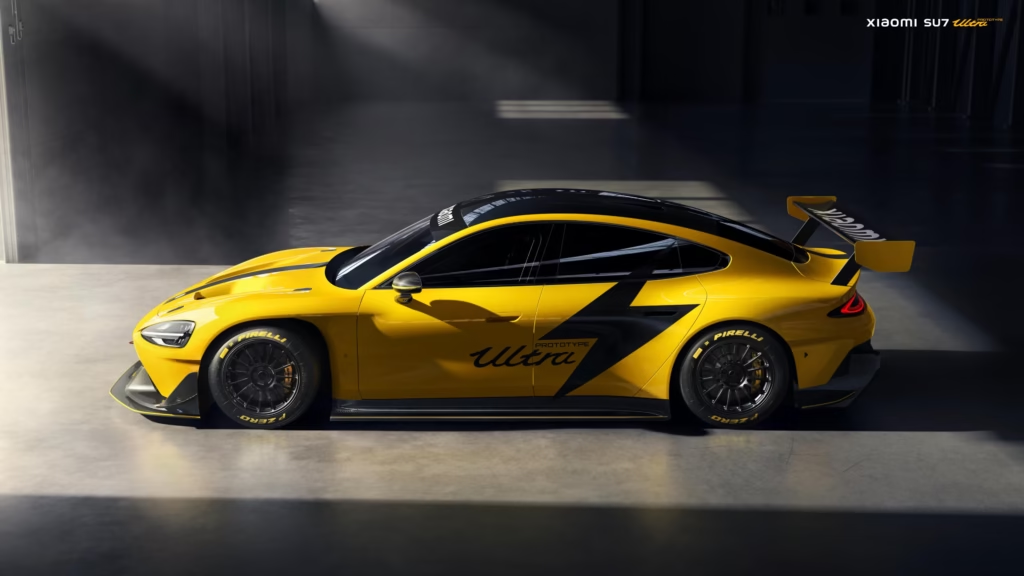
Often referred to as the “Green Hell,” the Nürburgring is one of the world’s most challenging racing circuits. Located in Germany, the track features numerous corners, dramatic elevation changes, and demanding driving conditions. Automakers from around the globe use the circuit to test and fine-tune their vehicles because it exposes weaknesses that may not become apparent during standard road testing.
For Xiaomi, testing vehicles at the Nürburgring provides valuable data that can be applied directly to production models. Engineers can evaluate suspension performance, steering precision, braking efficiency, battery management, and overall vehicle stability under extreme conditions. These insights help the company create cars that perform better not only on the track but also in everyday driving situations.
One of the key benefits of Nürburgring testing is improving vehicle handling. The demanding layout of the circuit challenges a car’s chassis, suspension setup, and weight distribution. By collecting data during high-speed laps, Xiaomi engineers can make adjustments that enhance cornering ability and driving confidence. These improvements can translate into a smoother and more controlled driving experience for customers on public roads.
Braking performance is another critical area of development. The Nürburgring’s long straights and challenging corners require repeated heavy braking, making it an ideal environment for testing brake systems. Through extensive track testing, Xiaomi can identify ways to improve brake durability, responsiveness, and thermal management. These enhancements contribute to increased safety and reliability in production vehicles.
Electric vehicle battery performance also benefits from rigorous track evaluation. High-speed driving places significant stress on battery systems, motors, and cooling components. Testing under these conditions allows Xiaomi to optimize thermal management systems and improve energy efficiency. Better temperature control can enhance battery longevity while maintaining consistent performance during demanding driving scenarios.
Safety remains a major focus throughout the development process. While performance often attracts attention, the ultimate goal is to create vehicles that remain stable and predictable in a wide range of conditions. Data gathered from track testing helps engineers refine electronic stability systems, traction control technologies, and advanced driver assistance features. These refinements can improve vehicle safety for everyday users.
Xiaomi’s growing investment in automotive engineering reflects its long-term ambitions in the electric vehicle market. The company has already demonstrated its willingness to compete with established automakers by focusing on advanced technology, software integration, and performance-oriented engineering. Applying Nürburgring experience to production vehicles further strengthens its position as a serious contender in the rapidly evolving EV industry.
Consumers increasingly expect electric vehicles to deliver more than just efficiency. Modern buyers want strong performance, engaging driving dynamics, and advanced technology. By incorporating track-derived knowledge into road-going vehicles, Xiaomi aims to meet these expectations while maintaining practicality and comfort.
The strategy also highlights a broader industry trend. Many leading automakers use motorsport and track testing as development tools for consumer vehicles. Xiaomi’s participation in this process demonstrates its dedication to achieving high engineering standards and delivering competitive products.
As the company continues developing new electric vehicles, Nürburgring testing is expected to play an important role in shaping future models. The lessons learned on one of the world’s most demanding circuits could help Xiaomi create production cars that offer a balanced combination of performance, safety, efficiency, and driving enjoyment.
FAQs
1. Why is Xiaomi testing vehicles at the Nürburgring?
Xiaomi uses the Nürburgring to evaluate vehicle performance, handling, braking, and durability under extreme conditions.
2. What is the Nürburgring?
The Nürburgring is a famous racing circuit in Germany known for its challenging layout and demanding driving environment.
3. How does track testing benefit production cars?
Track testing helps engineers improve suspension tuning, braking systems, battery performance, and overall vehicle safety.
4. Will Nürburgring lessons improve Xiaomi’s electric vehicles?
Yes, the data collected during testing can be used to enhance performance, reliability, efficiency, and driving dynamics in future production models.
5. Is Xiaomi serious about the automotive industry?
Yes, Xiaomi has made significant investments in electric vehicle development and aims to compete with established automotive manufacturers.